The Event Horizon for Leaders: to what degree is your organisation aligned to the outcomes you care about?

More than 170 senior executives gathered at CodeNode for The Event Horizon for Leaders to examine why value disappears between strategy and execution. The evening culminated in the unveiling of MissionHub Sense, Sullivan & Stanley's new AI-powered diagnostic capability and encouraged a broader conversation about whether organisations can truly see their own alignment problems before they become performance problems.
Key terms
Organisational alignment: The degree to which an organisation's people, priorities, structures and decisions are genuinely oriented towards the same outcomes. Sullivan & Stanley's research found that despite high leadership confidence in strategy, only 7% of organisations consistently realise the full value of their transformation programmes.
Value leakage: The gap between what a transformation programme was expected to deliver and what it actually delivers. On average, organisations lose more than a quarter of expected transformation value between ambition and execution.
Strategic sensing: The capability to continuously assess organisational alignment, execution risk and strategic readiness in real time, rather than relying on periodic reviews or retrospective analysis.
MissionHub Sense: Sullivan & Stanley's AI-powered diagnostic capability, designed to help leadership teams understand how aligned their organisation is to the outcomes they care about, at a pace and cost that traditional consulting methods cannot match.
At The Event Horizon for Leaders, more than 170 senior executives gathered at CodeNode in London to explore a challenge that sits at the heart of almost every transformation programme today: why does so much value disappear between strategy and execution?
Across the evening, leaders shared experiences of stalled programmes, fragmented accountability, AI initiatives struggling to scale and the growing pressure to deliver measurable outcomes in increasingly complex environments. While the conversations covered technology, operating models, leadership and culture, a common theme emerged: organisations are making significant transformation investments without always having a clear view of whether they are genuinely set up to succeed.
That challenge formed the backdrop to the unveiling of MissionHub Sense, Sullivan & Stanley's new AI-powered diagnostic capability. More importantly, it sparked a broader discussion about organisational alignment and why leaders need better ways to understand where value is being created, where it is being lost and how quickly they can respond when conditions change.
Standing on stage, Sullivan & Stanley’s CEO, Andy Haley, posed a question that seemed to resonate across the room:
"To what degree is my organisation aligned to the outcomes I care about?"
It's a deceptively simple question. Yet for many leadership teams, answering it quickly and confidently is surprisingly difficult.
And that matters because before organisations can close the strategy-to-execution gap, they first need to be able to see it.
This idea sits at the heart of Sullivan & Stanley's Intelligent Enterprise research.
The findings revealed a striking contradiction. More than 90% of leaders told us they were confident in their strategy, yet only 7% of organisations consistently realise the full value of their transformation programmes. On average, organisations lose more than a quarter of the value they originally expected to achieve.
| What leaders believe | What the data shows |
|---|---|
| 90%+ confident in their strategy | Only 7% consistently realise full transformation value |
| 88% say funding is easy to secure | Organisations lose an average of 27% of expected value |
| High confidence in delivery capability | Execution gap persists across sectors and organisation sizes |
The question isn't whether leaders know where they want to go. The question is whether the organisation is truly aligned around getting there. That gap between ambition and outcomes was one of the defining themes of the evening.
Seeing the problem before it becomes the problem
Traditionally, organisations have relied on strategy reviews, transformation health checks, operating model assessments and programme audits to understand how effectively they're performing.
The challenge is that most of these activities happen periodically. They provide a snapshot in time.Meanwhile, the organisations themselves continue to evolve.
Priorities shift. Market conditions change. New technologies emerge. Teams reorganise. Leaders move on. Assumptions that felt sound six months ago quietly become outdated.
By the time issues become visible through missed milestones, budget overruns or disappointing outcomes, the underlying causes have often been present for months. Several panellists touched on this challenge during the evening.
Helen Bliss, a seasoned Transformation Director, currently working at Nest Pensions, spoke about the importance of understanding the interdependencies that sit beneath transformation programmes and the risk of building on unstable foundations.
Paul Cooper, CTO at Serco discussed the complexity of maintaining alignment across large organisations, particularly when different parts of the business are moving at different speeds.
And Dan Eddie, Customer Operations Director at AXA Health reflected on the importance of business readiness, highlighting that successful transformation depends as much on organisational preparedness as it does on technology itself.
Taken together, the discussion pointed towards a broader leadership challenge. In increasingly complex organisations, visibility is becoming every bit as important as delivery capability.
Alignment is where value is won or lost
One of the strongest themes running through the evening was that value leakage rarely happens because people aren't working hard enough. More often, it happens because organisations gradually become misaligned.
Different functions optimise for different priorities. New initiatives are introduced. Legacy programmes continue because they've always existed. Teams make sensible decisions locally, but collectively those decisions can pull the organisation in different directions.
The result is often invisible until much later, when benefits fail to materialise, programmes slow down or leaders begin asking why the outcomes promised in the business case still feel just out of reach.
This is what makes the 7% figure so significant. If only a small minority of organisations consistently realise the value they expect from transformation, then improving organisational alignment becomes one of the biggest opportunities available to leadership teams.
Even modest improvements in alignment can unlock disproportionate value. Because when people are working on the right things, in the right order and with a shared understanding of the outcomes they're trying to achieve, execution becomes dramatically more effective.
The shift from hindsight to insight
This formed the backdrop to the introduction of MissionHub Sense. Led by Client Principal, Imogen Swaffer and Lead AI Consultant, Archie Cobb, they showcased not another transformation tool or dashboard, but a bigger idea:
-
What if leaders could gain a clearer picture of how aligned their organisation actually is?
-
What if they could identify execution risks earlier?
-
What if they could understand where value is leaking before it shows up in performance metrics?
-
And what if gaining that insight didn't require months of interviews, workshops and consulting effort?
Historically, answering those questions at enterprise scale has been difficult, time-consuming and expensive. It often required teams of consultants, extensive stakeholder interviews and months of analysis before leaders received a meaningful picture of what was happening across their organisation.
AI changes that equation. For the first time, organisations have the ability to continuously assess strategic alignment, organisational readiness and execution risk at a pace and cost that simply wasn't possible before.
The live demonstration explored how AI can help organisations assess strategic alignment, organisational readiness, execution risk and competitive positioning in a fraction of the time traditionally required.
What resonated most strongly wasn't necessarily the technology itself. It was the recognition that many organisations are still making significant decisions based on fragmented information, inconsistent reporting and assumptions that may no longer hold true.
The appetite in the room for greater visibility was clear.
Becoming an Intelligent Enterprise
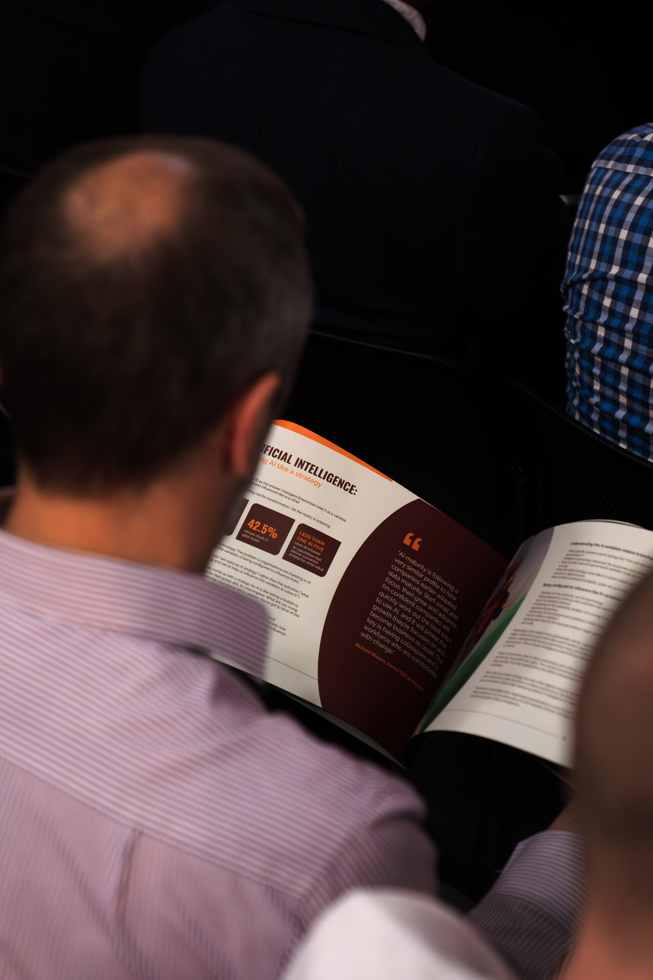
One of the ideas that ran throughout The Event Horizon was that successful organisations are increasingly distinguished not by the quality of their strategy documents, but by their ability to continuously sense, adapt and respond.
That was reflected in the audience polling too.
When asked how their organisations currently treat strategy, only 6% of attendees said their organisation actively tests assumptions and evolves strategy as new insight emerges.
In contrast, 28% said change tends to happen only when market conditions force it. That feels significant. Because the pace of change facing leaders today is unlikely to slow down.
AI is accelerating decision cycles. Customer expectations continue to evolve and competitive threats emerge from increasingly unexpected places. The organisations that thrive will be those that can spot change earlier, understand its implications faster and respond with confidence.
That is ultimately what the Intelligent Enterprise is about. Not simply deploying new technology or pursuing transformation for its own sake. But creating an organisation capable of continuously understanding itself and adapting accordingly.
MissionHub Sense is one contribution towards that ambition. Not because it replaces leadership judgement, but because it helps leaders answer one of the most important questions facing organisations today:
"To what degree is my organisation aligned to the outcomes I care about?"
Judging by the conversations that followed the session, it's a question many leadership teams are increasingly asking themselves.
And if you're finding it difficult to answer quickly and confidently, that may be the clearest signal that there is value still waiting to be unlocked.
Interested in learning more?
MissionHub SENSE is currently available to a limited number of organisations as part of its early rollout programme. If you'd like to join the waiting list or explore how it could support your organisation's transformation ambitions, we'd love to hear from you.
Find out more and join the waiting list →
About Andy Haley
Andy Haley is CEO of Sullivan & Stanley, a challenger transformation consultancy. He works with senior leadership teams across the UK to close the gap between transformation ambition and delivered value, at the intersection of execution, people and emerging technology.
Sullivan & Stanley, The Intelligent Enterprise Report, 2026

Ricky Wallace
Head of Marketing