Operating Models in the Age of AI: Why Scaling AI Means Rethinking How Your Business Works

In short
Only 15.5% of organisations have scaled AI to capture value, while 42.5% are still experimenting, according to our Intelligent Enterprise research. The gap usually comes down to the AI operating model: strategy, governance, data, skills, tooling, processes, architecture and change all need to move together for AI to scale.
Scaling AI means rethinking your AI operating model because most organisations bolt AI onto processes that were never redesigned for it. Progress comes from understanding how work happens today, separating deterministic, judgement and decision work, and building the governance, data and architecture that let a first success repeat across the business.
AI experimentation is everywhere. Enterprise value is not.
Our latest Intelligent Enterprise research found that 42.5% of organisations are still experimenting with AI, while only 15.5% have scaled it to capture value. At the same time, 90% of C-suite leaders are confident in their strategy, yet just 7% say their organisation consistently delivers against it.
That gap tells us something important. The technology itself is increasingly not the constraint.
The operating model is.
That was the focus of our latest webinar, where Sibbs Singh, Head of Consulting, and Archie Cobb, AI & Data Service Lead at Sullivan & Stanley, explored what happens when AI moves beyond individual tools and experiments and starts changing how work gets done.
The discussion covered everything from AI agents and data architecture to governance, skills and organisational design. But beneath the complexity was a relatively simple message: organisations cannot bolt AI onto the way they already work and expect transformational results.
They need to rethink the model around it.
Our AI maturity model describes how organisations make that shift in three stages:
- AI experimentation: real activity and enthusiasm, but no infrastructure to scale value across the enterprise.
- Integrated agentic: a context layer starts to form, with agents beginning to operate underneath it, though without system integration they still work as islands.
- Agentic enterprise: a hybrid workforce, where agents and humans operate as a coordinated team.
This article focuses on the practical steps from experimentation towards integrated agentic, and on what needs to be in place before an organisation is ready to become an agentic enterprise.
AI is becoming the context, not another transformation project
For years, organisations have treated new technology as something to implement. A new ERP platform. A CRM transformation. A cloud migration. A new digital channel.
AI is different because its impact is not contained within a single system or programme.
It is already changing how employees work, how customers find information and, increasingly, how decisions and actions are made.
One possibility discussed during the session brings this into sharp focus: what happens when your customer is no longer the person interacting directly with your business, but an AI agent acting on their behalf
Customers may increasingly use agents to research products, compare providers, make recommendations and eventually transact. That could mean they never visit your website or interact with the customer journey you have spent years optimising.
That changes questions of customer experience, brand, technology investment and service design at the same time.
It also exposes a problem with traditional target operating models. When technology and behaviour are evolving this quickly, designing towards a fixed state several years away becomes increasingly difficult.
The operating model itself needs to become adaptive.
Before automating the business, understand how it works
One of the most useful distinctions from the session was between what we called the founder's map and the floor map.
The founder's map is how an organisation believes a process works. For example:
An enquiry arrives. A quote is created. The product or service is delivered. An invoice is raised.
Four neat steps.
The floor map is what happens.
Someone exports information into a spreadsheet. Another person manually reconciles it. A colleague chases an approval. Information gets entered twice. A customer request changes and the process loops backwards.
None of this necessarily appears on the official process diagram, but it is where much of the organisation's time, knowledge and risk sits.
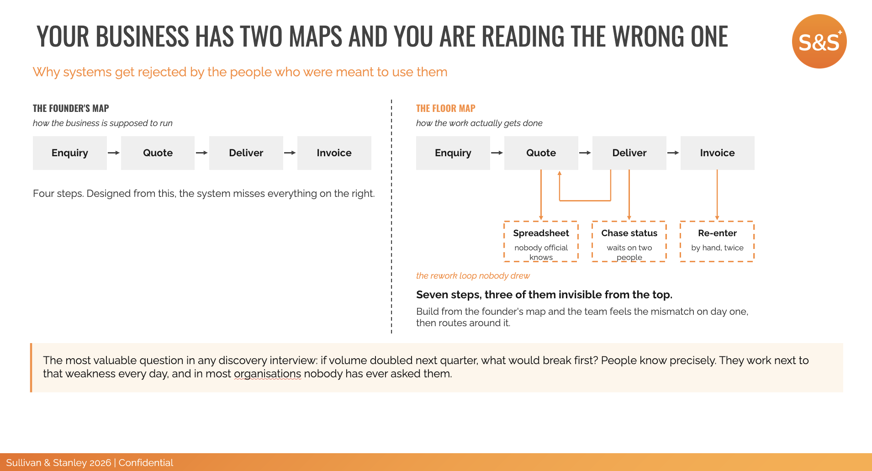
Your business has two maps — and most leaders are reading the wrong one.
That matters enormously when introducing AI. Automating an idealised process does not remove the real work. It simply builds technology around an incomplete understanding of it.
As Archie explained during the session:
"The coordinator and their manager will describe the same process differently, and the coordinator's version is the accurate one."
There is a simple question leaders can use to expose this: If the volume of this process doubled next quarter, what would break first?
The people closest to the work usually know the answer immediately. And that is often where the AI conversation should begin.
Not everything should be an AI agent
Once you understand the work, the next step is to separate it into three categories.
Deterministic work follows clear rules. If X happens, do Y. Traditional automation is usually better suited to this than AI.
Judgement work involves interpreting or generating something. Understanding the intent of an email, classifying an exception or drafting a response from several sources are examples where an AI agent may add value.
Decision work carries consequence and accountability. AI can assemble the information and dramatically reduce the effort involved, but a human may still need to make the final call.
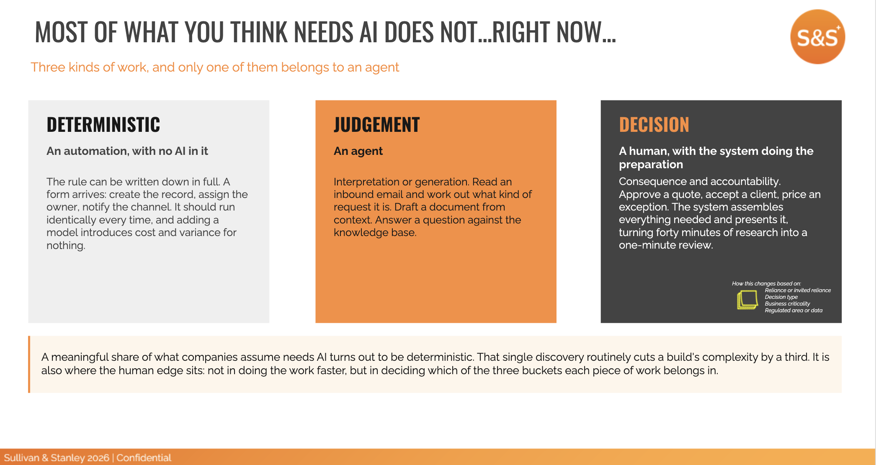
Most of what you think needs AI does not — right now: deterministic, judgement and decision.
This distinction sounds straightforward, but it can remove a significant amount of unnecessary complexity.
Many organisations are currently asking, "Where can we use AI?" when a better question is, "What kind of work is this?"
If a task can be expressed as a predictable rule, adding a large language model can introduce cost and unpredictability without adding value. Equally, forcing people to spend hours gathering information for a decision that an agent could prepare in seconds wastes human capability.
The goal is not to make everything agentic. It is to design the right relationship between automation, agents and people.
Scaling AI requires eight parts of the organisation to move together
This is where operating models become critical.
We assess AI maturity across eight interconnected components: strategy and vision, governance, people and skills, data, tooling, processes, architecture and change.
Organisations rarely mature evenly across all eight.
A business might have sophisticated AI tooling but fragmented data. It might have excellent experimentation happening inside individual functions but no enterprise governance. Or it might have invested heavily in technology without redesigning the processes employees are expected to use it within. That creates a ceiling on scale.
During the webinar, one community member described their AI strategy as being "completely in isolation from our business strategy", with experiments happening across business and technology teams without the two necessarily lining up together. It is a challenge we increasingly see.
Buying better technology will not solve an immature process, unclear accountability or poor data. In fact, AI can amplify those weaknesses because it allows organisations to execute against them faster.
The component furthest behind can therefore become the constraint on everything else.
| Component | Experimentation | Integrated agentic | Agentic enterprise |
|---|---|---|---|
| Strategy & vision | Ad hoc, no AI strategy | Priorities tied to value, with a funded roadmap | AI fused with business strategy |
| Governance | Little or none, shadow AI | A forum with intake and risk controls | Enterprise-wide, explainable and regulator-ready |
| People & skills | Isolated enthusiasts | Champions and communities of practice, humans in the loop | Hybrid workforce with a sustainable pipeline |
| Data | Fragmented and ungoverned | Priority data products with context | A knowledge graph feeding agents |
| Tooling | Scattered tools and licences | An owned, integrated stack | A composable agentic platform |
| Processes | Manual, AI bolted on | Priority workflows redesigned | Agent-first, agent-to-agent |
| Architecture | Proof of concepts outside the architecture | A reference architecture emerging | Scalable and secure, with agent identity |
| Change | Push adoption, low trust | Structured, evidence-led adoption | Embedded, continuous learning |
What good looks like: eight components across three stages, from experimentation to the agentic enterprise.
Start small, but design for scale
This does not mean organisations should spend two years perfecting their foundations before doing anything useful with AI. The opposite is true.
One practical example discussed during the webinar looked at purchase-to-pay within a finance function.
At first glance, it appears to be an obvious candidate for AI. But once the workflow was broken down, four of six steps were deterministic and could be handled through conventional automation. Two required AI judgement, while a consequential approval remained with a human. That immediately made the problem smaller.
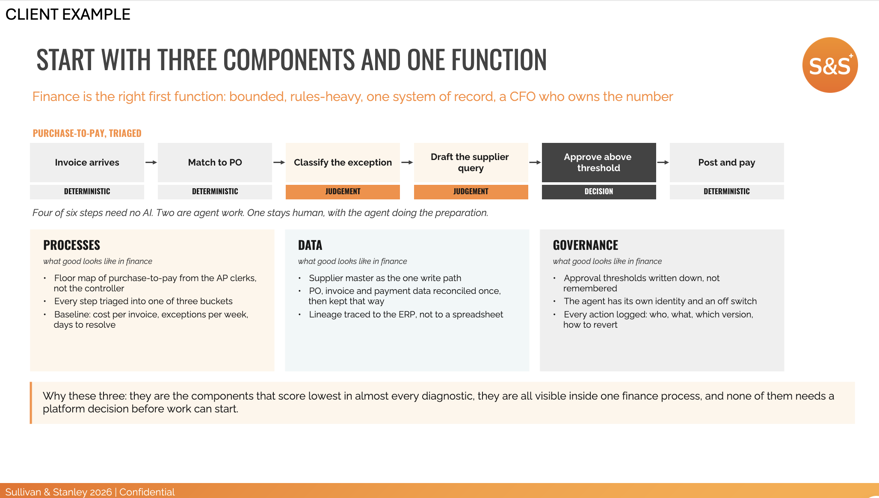
Start with three components and one function: the purchase-to-pay example, triaged into deterministic, judgement and decision steps.
The team could then focus on one workflow, establish a baseline, put the appropriate governance and data foundations around it and get something into production.
The important part is what happens next. The first implementation should not simply produce a successful use case. It should create reusable foundations for the next one: identity and permissions, governance patterns, audit trails, data structures and the architecture through which agents can operate.
As the session put it: The pattern travels, even when the floor map does not.
Finance will work differently from procurement. Procurement will work differently from HR. But the underlying controls and architecture do not need to be reinvented every time.
That is how experimentation starts becoming enterprise capability.
The human role becomes more important, not less
Much of the discussion around agentic organisations focuses on what AI will be capable of doing autonomously.
There is another question that matters just as much: Where should autonomy stop?
As agents gain access to systems, data and other agents, organisations need clarity about what each one can see, what it can do, whose authority it operates under and when a person needs to intervene.
This makes human judgement an architectural consideration, not simply a cultural one. It also means AI cannot belong exclusively to the technology function.
The CEO may set the ambition. Technology leaders create the environment in which agents can operate securely. HR needs to think about the future workforce and skills. Operations needs to redesign work. Risk and compliance need clear accountability. Business leaders need to own the outcomes.
The webinar discussion was clear on this point: there should not be one isolated "owner of AI". The challenge is creating shared ownership without losing individual accountability. That requires a different kind of leadership conversation.
Three questions to ask now
The path towards an agentic enterprise can sound daunting. It becomes much more manageable when you stop trying to redesign the whole organisation at once.
There are three practical things leaders can do now.
First, get the floor map. Pick one high-volume process and sit with the people who run it. Find the workarounds, rework and hidden steps that do not appear on the official diagram.
Second, triage the work. Separate the process into deterministic work, judgement work and decisions. You may discover that far less of it requires AI than you expected.
Third, trace one AI action. Take something an AI system did recently and ask whether you can identify what version performed it, under whose identity and permissions it acted, where it sat within the process and who was ultimately accountable for the outcome.
Where you cannot answer is likely to tell you where your operating model needs attention.
The organisations that capture the most value from AI will not necessarily be those that buy the most tools or launch the most pilots. They will be the ones that understand how their business really works, redesign it deliberately and create an operating model in which humans, automation and AI agents can work together.
Because the future of AI transformation is not really about adding AI to the enterprise. It is about designing the enterprise around a fundamentally different way of getting work done.
Keywords
- Operating model: how an organisation's strategy, governance, people, data, tooling, processes, architecture and change work together to get work done.
- AI maturity model: Sullivan & Stanley's framework for how organisations move from experimentation to integrated agentic to becoming an agentic enterprise, assessed across those eight components.
- Deterministic work: work that follows clear rules, so traditional automation is usually the better fit.
- Judgement work: work that involves interpreting or generating something, where an AI agent may add value.
- Decision work: work that carries consequence and accountability, where AI can prepare the information but a human may still make the final call.
- Founder's map: how an organisation believes a process works.
- Floor map: what happens when the process runs in practice.
- Agentic enterprise: the stage where AI is fused with business strategy and processes run agent-first, agent-to-agent
Frequently asked questions
What is an AI operating model?
An AI operating model is the way an organisation designs its strategy, governance, people and skills, data, tooling, processes, architecture and change so that humans, automation and AI agents can work together. We assess maturity across each of these eight components because scaling AI depends on all of them moving together.
Why do organisations struggle to scale AI?
Our Intelligent Enterprise research found that 42.5% of organisations are still experimenting with AI and 15.5% have scaled it to capture value. Organisations rarely mature evenly across the eight components, and the component furthest behind becomes the constraint on everything else. A business might have sophisticated tooling but fragmented data, or strong experimentation inside individual functions but no enterprise governance
What are the stages of AI maturity?
Our AI maturity model has three stages: experimentation, integrated agentic and agentic enterprise. Each stage is assessed across the same eight components, and the first implementation in one function should create reusable foundations that make the next one easier.
When should an organisation use an AI agent instead of traditional automation?
It depends on the kind of work. Deterministic work follows clear rules and is usually better suited to traditional automation. Judgement work, such as understanding the intent of an email or classifying an exception, is where an AI agent may add value. Decision work carries consequence and accountability, so a human may still make the final call while AI assembles the information.
Where should an organisation start with AI at scale?
Start with one high-volume process in one function. Get the floor map by sitting with the people who run the process, triage the work into deterministic, judgement and decision steps and trace one AI action to see who was accountable for the outcome.

Ricky Wallace
Head of Marketing