Is traditional strategy dead?: Why the 5-year plan is becoming a liability – and why the real problem isn’t your roadmap, it’s your people

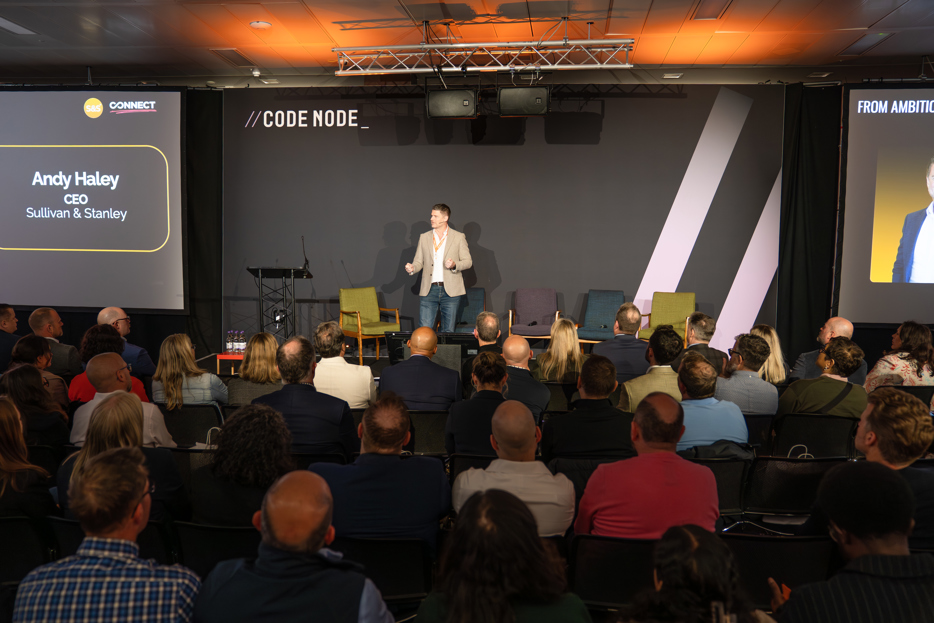
Last week at The Event Horizon for Leaders, Sullivan & Stanley brought together over 170 senior leaders to explore a question many organisations are now wrestling with in real time: why, despite unprecedented investment in transformation, are so few businesses consistently realising the outcomes they set out to achieve?
Across the evening, from candid panel discussions through to audience polling and our keynote from Dr Jo Salter MBE, one theme surfaced repeatedly: organisations don’t have a shortage of strategy. They have a shortage of alignment, adaptability and execution confidence.
That conversation sits at the heart of what we call the Intelligent Enterprise – organisations able to continuously align strategy, technology, people and execution in response to changing conditions, without losing momentum or leaking value along the way.
This blog is the second in our Event Horizon for Leaders series and explores one of the most debated themes from the evening: whether traditional approaches to strategy are now becoming a constraint rather than a competitive advantage.
Since the dawn of large organisations, there has been a fairly common – and, for the most part, effective – 5-year strategic cycle. A few million would be spent on the definition of a strategy, supported by impossibly smart consultants with letters after their names, and presented to the board. Post sign-off, a roadmap would be generated with all the required financial due diligence and business case development which, after another board-level review, would be transitioned to execution.
What followed would be up to five years of head-down delivery that was often likened to trench warfare, given how challenging large-scale transformation can be to implement.
“The model worked. Until, increasingly, it didn’t.”
Research we’ve commissioned tells a revealing story. While this cycle is still largely the norm, there is a significant loss of signal along the way.
|
8 in 10 leaders confident in their strategy |
70% of promised value actually delivered |
7% of firms consistently deliver on transformation value |
At The Event Horizon for Leaders, we tested some of these themes live with the audience. Only 6% of attendees said their organisations actively test assumptions and evolve strategy as new insight emerges. Meanwhile, 28% described their organisations as largely reactive, adapting only when market conditions force them to.
That gap matters.
Because value leakage rarely happens in one dramatic moment. It happens gradually: through delayed decisions, misaligned priorities, transformation fatigue, disconnected operating models and leadership teams still treating strategy as something fixed rather than something living.
Strategy as a guide, not a gospel
At Sullivan & Stanley, we curate a thriving set of executive communities, and attending those events remains a genuine highlight. We recently hosted a CEO dinner where the conversation took a sharp and clarifying turn. Every person around the table was enthusiastically aligned to one idea: the strategy must be challenged – often – through execution. And executives need to be brave enough to pivot when results aren’t landing as expected.
That same tension surfaced again just days later at The Event Horizon for Leaders, where one audience member summarised the challenge perfectly in our live polling:
“Execution is key.”
Simple. But difficult in practice.
It got me thinking. Is it becoming common practice to treat strategy as a living guide rather than a locked-in mandate — reviewed regularly, stress-tested in real time, and revised without apology? As agility (small ‘a’) is increasingly sought-after in large and potentially complex environments, the question worth asking is: where is most of the friction actually coming from?
My heritage is in banking, and a lot of the friction there comes from legacy technology — deeply embedded systems that aren’t easy to unwind, no matter how good your strategy is. But that’s only part of the story. And arguably, it’s no longer the hardest part.
The friction that nobody talks about enough
What I’m seeing more and more, as technology and processes become genuinely more agile, is that it’s the humans who need to be ready to pivot. The systems are catching up. The people often aren’t.
“In the age of AI having an answer to everything, are we not caring enough about the most valuable asset we have?”
The honest answer, in my experience, is no. We are not.
Embedding the value of change — so that it sustains — means getting the people in a business genuinely comfortable with never standing still. It means making them confident that change, done well, makes things better rather than worse. And critically, this isn’t something you can deliver through a change programme with a start and end date. It’s a cultural norm. One that is built through years of deliberate, consistent, and – crucially – gentle conditioning across every level of an organisation.
This is exactly why the Intelligent Enterprise conversation matters.
Too many organisations still approach transformation as a technology deployment exercise, when in reality the organisations creating sustainable advantage are the ones building cultures capable of adapting continuously without destabilising people in the process.
At the event, one of the strongest recurring themes from the audience was the challenge of leading people through difficult change. That is a very different leadership challenge.
Embedding the value of change, so that it sustains, means getting the people in a business genuinely comfortable with never standing still. It means making them confident that change, done well, makes things better. And critically, this isn’t something you can deliver through a change programme with a start and end date. It becomes a cultural norm, built through years of deliberate, consistent, and gentle conditioning across every level of an organisation.
What good actually looks like
Organisations that get this right don’t announce change as an event. They build it into the operating rhythm. Leaders model comfort with uncertainty — visibly, repeatedly, and without spin. Teams are given genuine autonomy to surface when something isn’t working, without fear that doing so signals failure. And crucially, the narrative around change is consistently one of improvement, not disruption.
This takes time. It can’t be retrofitted into a transformation programme or solved with an all-hands presentation. It has to be lived — in the small moments as much as the large ones. A manager who responds to an unexpected result with curiosity rather than blame. A board that celebrates a well-reasoned pivot as readily as it celebrates hitting a target. A culture where “we changed course because the evidence told us to” is seen as a mark of intelligence, not weakness.
The strategic implication
So yes — I think the traditional 5-year strategy, as a fixed and largely immutable document, is increasingly a liability. The organisations pulling ahead are the ones treating strategy as a hypothesis: directionally sound, but held loosely enough to evolve as reality unfolds.
But the technology to support that kind of agility now exists. The processes are being redesigned. What lags — what almost always lags — is the human readiness to operate in that way comfortably, consistently, and sustainably.
In a world where AI can synthesise market signals, model scenarios, and challenge assumptions faster than any strategy consultant, the competitive advantage won’t come from having the best strategy document. It will come from having the most change-ready people.
And perhaps that was the clearest takeaway from The Event Horizon for Leaders overall.
The future advantage for organisations will not come from having access to the same AI tools, platforms or transformation methodologies as everyone else. Those are increasingly available to all.
The differentiator will be whether leaders can create organisations capable of continuously sensing, adapting and executing without losing people, pace or clarity along the way.
That is what the Intelligent Enterprise ultimately requires. And most organisations are only just beginning that journey.

Andy Haley
CEO