Designing Operating Models that Deliver: What Gets in the Way and What Helps

Yesterday morning, I had the pleasure of hosting our cross-community virtual session, bringing together leaders from across the UK and UAE to work through a challenge we come across time and time again: why operating models struggle to deliver predictable outcomes and what organisations can do differently.
In facilitating these discussions, I’m always struck by how consistently the same themes surface across sectors. Despite different contexts, many organisations face similar friction points. Today was no exception. The conversation was open, honest and reflective, exactly what makes these sessions so valuable.
Below is a combination of what I regularly see across operating model programmes, paired with the experiences and perspectives surfaced in today’s discussion.
1. Strategy translation is the work most organisations skip
Most organisations have a strategy. Far fewer have one that teams can confidently translate into day-to-day decisions.
Attendees described strategy documents that were either too high-level to guide work, or so excessively detailed (one Community member cited a 270-page version) that no one could meaningfully act on them. Teams end up “articulating the strategy they wish existed”, rather than the one the organisation is pursuing
One comment summed it up neatly: “If your strategy can’t be understood on one page, it won’t be lived across the organisation.” This gap between intent and execution continues to be one of the most consistent operating model failure points we see.
2. Prioritisation Still Defaults to Volume, Not Value
The group spoke candidly about prioritisation frameworks that look robust on paper but fail in practice. Common patterns included:
- Decision changes driven by influence rather than evidence
- Work being reshuffled based on urgency, not value
- A lack of transparency behind trade-offs
- Teams feeling like they “must escalate everything” because accountability is unclear
An attendee shared: “We do what feels important, not what’s strategically aligned.”
This creates organisational drag, rework, and ultimately slower speed-to-value. These are all symptoms of a deeper model misalignment, not just a people or culture issue.
3. Structure and Roles Are Clear Internally… Until Work Becomes Cross-Functional
When the group mapped their organisations’ maturity across roles, structure and sourcing, most self-assessments fell between 1 and 3 out of 5. The themes were consistent with what we frequently diagnose: roles that are documented but not understood; titles that sound empowered but don’t map to decision rights; informal influence overriding the formal operating model.
A specific example came up around IT functions. Internally, roles were well-defined, but as soon as work crossed into the business when service needed to interface with a non-technical team, accountability blurred. Everything escalated and nothing moved.
One phrase captured the experience for many: “Grenades and torpedoes on the daily.”
When informal norms override formal design, even well-structured functions struggle to deliver predictably.
4. What the Diagnostics Revealed
Using a simplified version of the diagnostic we use with clients, the group mapped their organisations’ maturity across two areas:
- Purpose, Strategy & Value: Most scores sat around 2, indicating: Some structure exists but behaviours, alignment and consistency are not yet embedded.
- Organisation, Roles & Sourcing: Scores varied more widely (between 1 and 3), showing: Pockets of clarity, but limited cross functional alignment and inconsistent decision ownership.
No organisation in the room scored above 3 on any question.
On purpose, strategy and value, the picture was striking. 70% of participants rated their organisation at 2 out of 5 on whether strategic priorities are clearly translated into actionable outcomes for teams. On trade-offs being made based on strategy rather than politics, 42% scored themselves at 1. The question about priorities changing with transparent rationale drew the lowest confidence of all: 55% rated their organisation at 1.
Across both components, scores clustered at 1 and 2. The lowest single score: 75% rated their organisation at 1. On cross-functional collaboration happening with minimal territorial friction, 71% said the same.
The full diagnostic results are below.
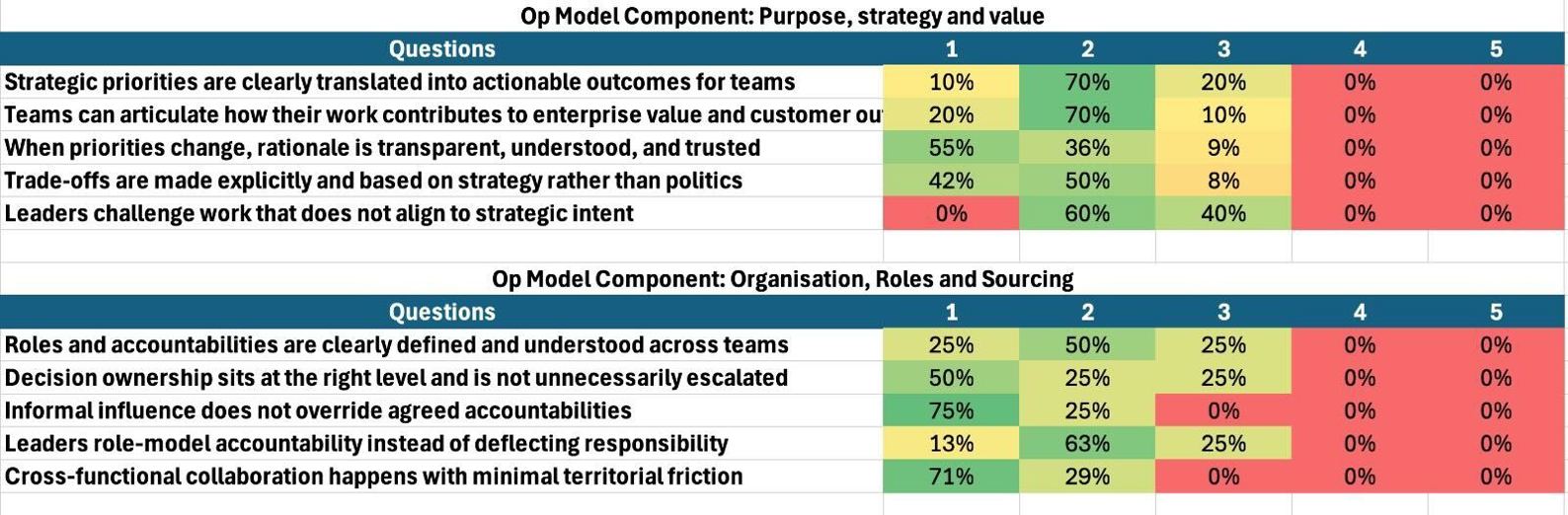
This spread across organisations reinforced a familiar truth: even high performing teams experience friction when the operating model isn’t consistently reinforced end-to-end. Diagnostics are valuable as they surface where the friction is sitting, not just where leadership assumes it to be.
5. Practical approaches to move from knowing the model to living it
We spent the second half of the session exploring practical actions, the approaches that consistently shift organisations from “knowing the model” to “living the model.”
A few that resonated strongly with the group:
- Set design guardrails early: Clear, agreed principles reduce debate, accelerate decision-making, and keep the model anchored to strategic intent.
- Make value visible: Outcome based dashboards, OKRs and prioritisation matrices help teams understand the “why” behind decisions and reduce political noise.
- Test before scaling: Using a “prove” phase allows teams to validate role clarity, decision pathways and new rhythms with real work, not just theory.
- Simplify governance: Removing low value forums and reducing reliance on escalation frees capacity and increases ownership where the work sits.
- Rebuild credibility where needed: Some functions (architecture was a common example) benefit from a reset: reframing the role, demonstrating value, and engaging the business differently.
- Treat operating model change as behaviour change: Clear communication, leader led reinforcement, aligned incentives and consistent language matter more than any structural diagram.
6. The janitor at NASA
One of the sharpest moments in the session came from an attendee who shared the familiar NASA story: a janitor, asked by the president what he’s doing, replies “I’m helping put a man on the moon.” It landed as several people in the room recognised it immediately as the thing they’re missing: many teams cannot clearly articulate how their day-to-day work contributes to strategic objectives and enterprise value. Without this line of sight, even the most technically sound operating model will struggle to deliver.
A Community member reflected on their own organisation: “We’ve created something quite different using different language and not really showing a neat thread back to our organisational strategy. We’ve made it difficult for our own people to see how their work connects.”
Final reflections
Today’s conversation echoed what we see across many organisations:
- The challenges are common
- The root causes are systemic
- And the solutions require both design and behavioural change
The encouraging part is that these issues are solvable, often with targeted, focused interventions (the right diagnostic, clear guardrails, simplified governance) that create immediate impact without a full-scale redesign.
If you joined the session, thank you for your openness and contribution. And if you’d like to explore your own operating model friction points or run a diagnostic with your leadership team, I’m always happy to continue the conversation.

Ellie Jarvie
Manager