Community Compass: What Our Community Members Are Bracing For in 2026

2025 brought relentless economic uncertainty, unending pressure to transform and the constant question of how to do more with less. By December, almost every person I spoke with—across our business, our Communities and our clients' organisations—surfaced the same sentiment: exhaustion. But alongside that fatigue, there was something else. A pervasive sense of optimism for 2026. Not naive positivity, but a kind of determined realism.
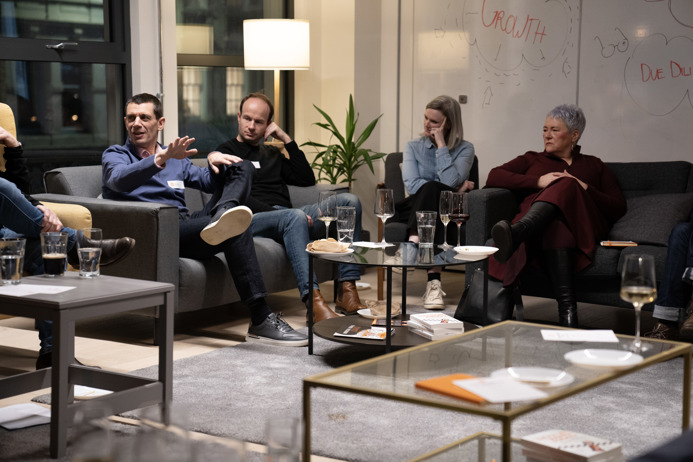
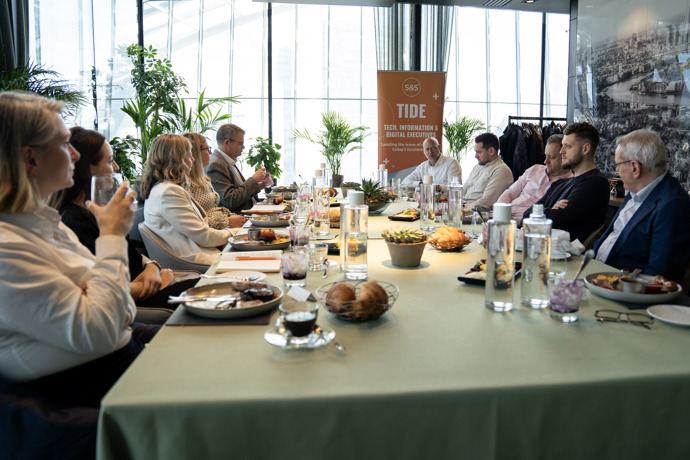
As Community Development Manager, I had the privilege of speaking to over 100 of our Community members at the 10 events we hosted in November and December for our Leaders in Transformation, Women in Transformation, TIDE (Technology, Information and Digital Executives), Inner Circle and CEO Communities. We discussed their specific challenges, but also the macro forces they expect will shape the year ahead. What emerged wasn't a wish list. It was a clear-eyed view of the imperatives leaders are already beginning to tackle.
Looking Back: What 2025 revealed about transformation
Before we look forward, I do think it is important to look back and establish some of the circumstances and challenges that have inspired these predictions.
Discussions reflecting on 2025 highlighted a convergence of challenges that constrained transformation effectiveness. Persistent economic pressure driven by higher costs of capital, investor scrutiny and constrained budgets created an environment where every initiative had to justify itself by delivering value immediately. AI enthusiasm outpaced organisational readiness, particularly in data maturity, governance and skills. Increasing change saturation meant leaders could be managing multiple initiatives competing for attention, resources and momentum. Cultural and workforce tension driven by hybrid work and generational shifts and fatigue added yet another layer of complexity.
As articulated across several of our Communities, transformation leaders were routinely asked to deliver more with less, while operating in environments where ownership of transformation remained fragmented and authority unclear. Crucially, these were not failures of intent or ambition. They were symptoms of operating models and governance structures not designed for the pace, complexity and scrutiny 2025 required.
Looking Forward: What 2026 has in store for businesses
What differentiates 2026, from what our Community members are telling us, is not a new set of priorities but a hardening of external forces that remove leaders' ability to defer difficult decisions.
Regulatory enforcement replaces regulatory anticipation. The EU AI Act, UK labour reforms, post-pandemic regulatory backlogs and sector-specific compliance requirements are no longer future concerns – they are entering enforcement phases. Leaders must now evidence control over AI, data, workforce practices and resilience, rather than rely on assurance alone.
Capital expectations intensify under volatility. With record private equity capital seeking deployment, refinancing cliffs approaching and economic volatility persisting, organisations face compressed timelines to demonstrate value. Transformation initiatives that cannot show measurable progress risk rapid defunding.
AI becomes operational, not experimental. AI is moving decisively into mainstream enterprise operations. Leaders are speaking less about pilots and more about AI agents, operational deployment and cost reduction, accompanied by anxiety around governance, accountability and workforce impact.
Workforce dynamics reach an inflection point. By 2026, Gen Z represents over a quarter of the workforce globally, while the ongoing "Great Retirement" places pressure on leadership continuity and institutional knowledge. Transformation leaders must now actively redesign workforce models rather than incrementally adapt them.
2026 Transformation Imperatives
Drawing on these macro forces and the lived experience shared during our 2025 community events, five imperatives stand out:
1. Proving control and compliance, not just asserting it
In 2026, leaders will be judged on their ability to demonstrate operational control across AI usage, data integrity, cyber resilience and workforce practices. Informal governance, ambiguous ownership and undocumented decisions become organisational risks rather than tolerable inefficiencies. This represents a shift from transformation as innovation to transformation as institutional credibility.
2. Demonstrating value at speed
Long-cycle transformation programmes are increasingly misaligned with economic and business reality. Leaders must show quarterly, evidence-based value, while being prepared to stop or reshape initiatives that fail to deliver. This doesn't imply short-termism, but rather disciplined value management. Prioritising outcomes over activity and clarity over optimism.
3. Redesigning the workforce, not just reskilling it
2026 demands a more fundamental rethink of workforce composition, role design and capability models. Leaders must simultaneously address skills transitions driven by AI, labour cost inflation, leadership capability gaps and employee confidence and engagement. Transformation increasingly becomes a people architecture challenge, not just a technology or process one.
4. Balancing autonomy and alignment across fragmented markets
Divergent regional, regulatory and market conditions require organisations to empower local decision-making while maintaining shared standards and risk controls. Leaders must design operating models that allow controlled autonomy, avoiding both centralised rigidity and decentralised chaos.
5. Scaling AI responsibly into core operations
As AI becomes embedded in everyday decision-making, leaders must move beyond pilots without over-promising value. The imperative is to integrate AI in ways that are governed, explainable, aligned to workforce capability and genuinely value-creating. This is less a technical challenge than a leadership and accountability one.

Where do we go from here?
Two weeks into 2026, I'm curious: do these hypotheses ring true? Have there already been circumstances that reinforce the popular thought that we're in an era where it's no longer possible to plan to prepare, only to sense and respond?
These are the kinds of discussions we work through in our Communities and will continue to do so throughout 2026. The challenges are real, but so is the collective intelligence we bring to them when we create space to talk honestly about what we're facing.
If you're interested in joining these conversations, I'd encourage you to learn more about our Communities and reach out if you'd like to get involved.
External resources:
AlphaSense. (2025). Macro outlook 2026. https://www.alpha-sense.com/resources/research-articles/macro-outlook-2026/
Deloitte. (2025). Tech trends. https://www.deloitte.com/us/en/insights/topics/technology-management/tech-trends.html
HRD Connect. (2025, December 11). AI anxiety takes centre stage: What Vistra's new research reveals about the future of workforce strategy in 2026. https://www.hrdconnect.com/2025/12/11/ai-anxiety-takes-centre-stage-what-vistras-new-research-reveals-about-the-future-of-workforce-strategy-in-2026/
IMD. (2025). Workplace trends for 2026. https://www.imd.org/ibyimd/talent/workplace-trends-for-2026/
McKinsey & Company. (2025). Superagency in the workplace: Empowering people to unlock AI's full potential at work. https://www.mckinsey.com/capabilities/tech-and-ai/our-insights/superagency-in-the-workplace-empowering-people-to-unlock-ais-full-potential-at-work