But my organisation wasn't built for AI! Why the technology is only half the challenge

Most organisations weren't designed for AI. Their structures, processes, leadership models and ways of working were built for a different era. Yet as artificial intelligence moves further into everyday business operations, leaders face growing pressure to demonstrate value from technology that their organisations may not be ready to support.
This was the challenge at the heart of a keynote delivered by Andy Haley, CEO of Sullivan & Stanley (S&S), at AI for Business Leaders Live 2026 in London. Bringing together business leaders, technology executives and AI practitioners, the event explored how organisations can move beyond the promise of AI and begin putting it to work in meaningful, commercially valuable ways.
In his session, ‘But my organisation wasn't built for AI!’, Andy challenged leaders to look beyond the technology itself and consider the organisational changes required to realise its potential. Drawing on his experience of leading complex enterprise transformation, he explored why AI adoption is exposing long-standing weaknesses in how businesses operate, and why addressing those weaknesses is becoming increasingly urgent. His core argument was that AI readiness depends on investing early in people, governance and ways of working, well before the technology is ready to scale.
The real legacy problem goes far beyond technology
For years, enterprise leaders have been trying to balance the demands of running today's business with preparing for tomorrow's. Cloud, digital and now AI have each accelerated expectations about what organisations should be capable of, while the underlying structures of many businesses have struggled to keep pace.
Andy described this as a growing tension between the present and the future. Leaders are expected to embrace new capabilities while continuing to operate within organisations shaped by decades of accumulated complexity.
Legacy technology is often blamed for slowing transformation, but it's only one part of the problem. Legacy processes, skills, mindsets and cultures can be equally restrictive, particularly when organisations introduce new technologies without addressing the conditions around them.
For Andy, the starting point isn't another technology strategy. It's understanding what the organisation is actually trying to achieve.
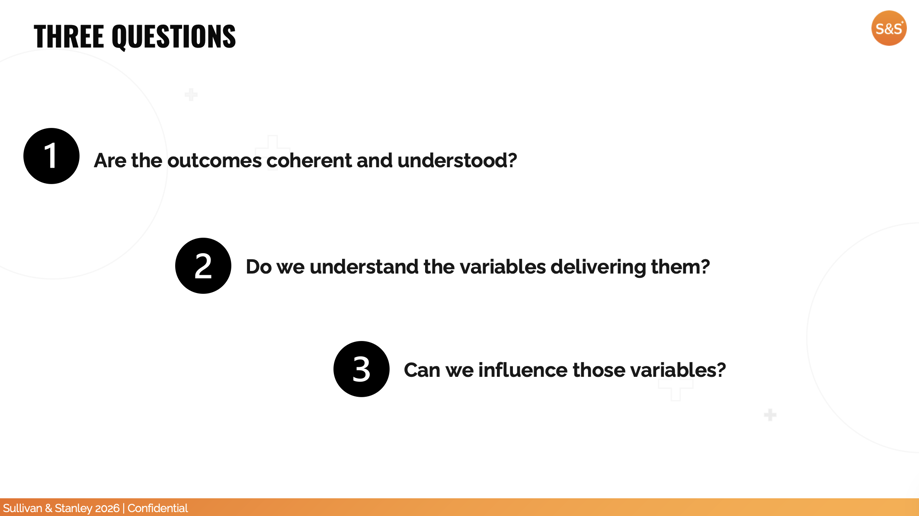
He challenged leaders to consider three fundamental questions before embarking on any major AI or transformation programme:
- Are the outcomes we care about coherent and understood?
- Do we understand the variables involved in delivering those outcomes?
- Can we influence those variables?
These questions sound straightforward, but answering them requires a much deeper understanding of how an organisation operates.
A business might invest in one programme designed to standardise processes while simultaneously pursuing another intended to increase flexibility and responsiveness. Individually, both initiatives may have compelling business cases, yet collectively they could undermine one another.
AI makes these tensions more significant. As organisations introduce agentic AI, with autonomous agents capable of making decisions and taking action, understanding the wider consequences of those decisions becomes increasingly difficult.
The implication for leaders is clear: before investing in AI at scale, organisations need to understand how their people, processes, technology, data and governance work together to deliver the outcomes that matter.
Moving from AI experimentation to enterprise-wide value
One of the biggest challenges facing organisations today is translating early AI success into sustainable business value.
Pilots are relatively easy to launch. Teams can experiment with new platforms, automate individual tasks and demonstrate impressive productivity improvements. But scaling those successes across a complex enterprise requires something much more fundamental.
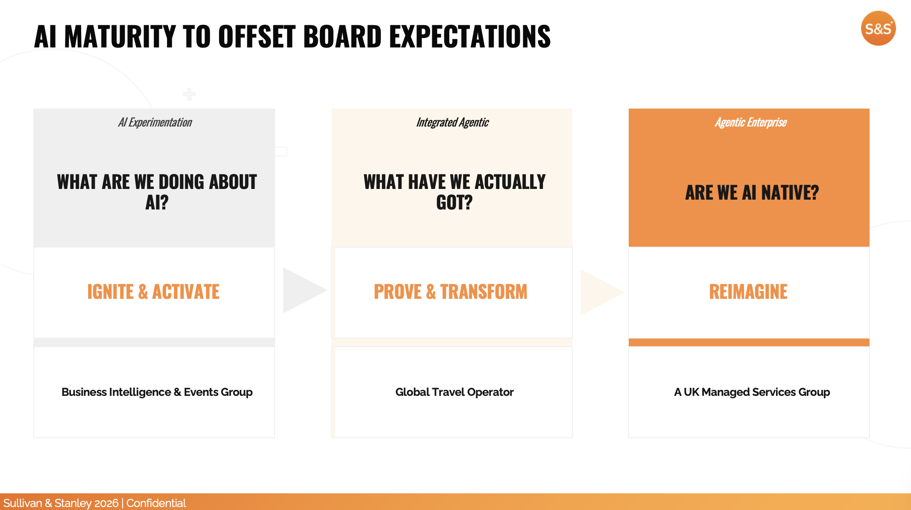
Andy outlined three overlapping stages of AI maturity, each characterised by a different question from the board.
- The first, Ignite and Activate, begins with 'What are we doing about AI?' Organisations explore the technology, launch pilots and build awareness of its potential.
- The second, Prove and Transform, asks 'What have we actually got?' Here, the focus shifts towards proving value, integrating AI into operations and establishing the foundations needed to scale.
- The third, Reimagine, challenges leaders to consider 'Are we AI native?' This requires organisations to rethink how work gets done, how decisions are made and how human and artificial intelligence operate together.
Crucially, these stages aren't entirely sequential. Organisations cannot simply complete a successful pilot and then begin thinking about the capabilities required to scale it.
As Andy explained, some of the most important investments, particularly those involving people, skills and culture, take considerably longer to deliver returns than the technology itself.
An organisation might deploy AI agents in weeks, but changing its talent strategy, governance arrangements or leadership behaviours could take months or years.
If those investments don't begin early enough, businesses risk reaching a point where the technology is ready to scale but the organisation isn't.
This creates a difficult balancing act for executives. They need to demonstrate near-term returns while investing in capabilities that may not generate immediate financial benefits.
The answer isn't to choose between short-term value and long-term transformation. It's to recognise that both must happen together.
Why human judgement matters more as AI becomes more capable
While much of the conversation around AI focuses on improving technical capabilities, Andy argued that organisations are paying insufficient attention to the people expected to work alongside it.
AI can produce convincing outputs, accelerate analysis and automate increasingly complex tasks. But fluency in using AI doesn't necessarily translate into good judgement.
This distinction has important implications for how organisations recruit, develop and promote their people.
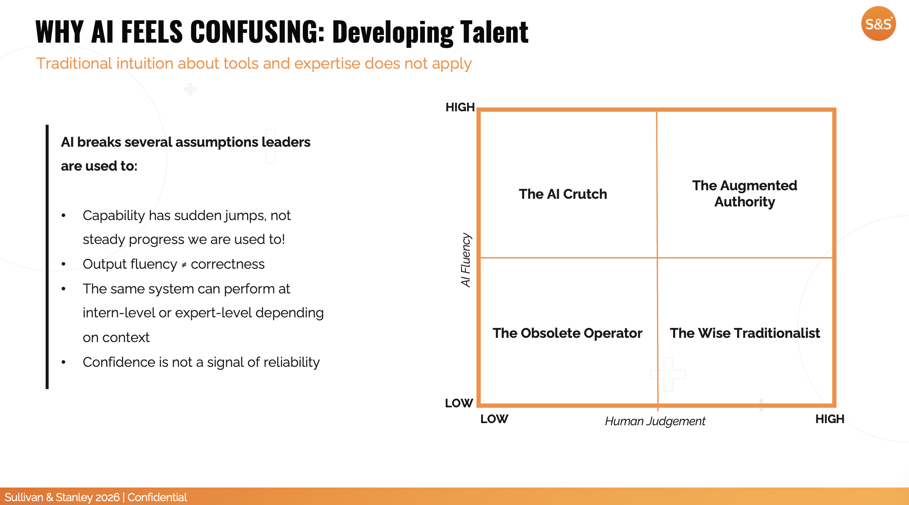
Andy introduced a framework that considers two dimensions: AI fluency and human judgement.
At one end are individuals with strong professional judgement but limited experience of AI. These 'Wise Traditionalists' may possess valuable expertise but need support in understanding how technology can augment their work.
At the other end are individuals who are highly fluent in AI but lack the critical thinking and experience required to challenge its outputs. Andy described this group as 'The AI Crutch', where dependence on technology risks replacing independent judgement rather than strengthening it.
The ambition should be to develop what the framework calls 'The Augmented Authority', people who combine deep human judgement with the ability to use AI effectively.
Achieving this requires more than offering employees training on the latest tools. Organisations need to develop curiosity, critical thinking and the confidence to question what AI produces as critical AI skills.
It also raises important questions about the future workforce. If AI increasingly automates tasks traditionally undertaken by junior employees, how will the next generation develop the experience and judgement needed to become tomorrow's leaders?
This was a concern raised during the audience discussion, and one that organisations will need to address deliberately rather than leaving professional development to chance.
Andy also challenged the traditional separation between technology and people leadership. As AI agents become part of the workforce, technology and HR leaders will need to work far more closely together on skills, accountability, workforce design and organisational culture.
Simply appointing a Chief AI Officer won't resolve these challenges if the wider leadership team hasn't reconsidered how the organisation needs to operate.
At S&S, this thinking sits at the heart of our Intelligent Enterprise approach, which brings together Human, Artificial, Technology and Execution Intelligence. Each plays a critical role, but human intelligence comes first because it's ultimately people who determine how technology is applied, governed and translated into value.
How to balance short-term AI returns with long-term readiness
The tension between immediate returns and long-term organisational readiness became particularly apparent during the audience Q&A.
One attendee, working within a private equity-backed business, described the pressure to demonstrate AI-driven value towards the end of an investment cycle, while recognising that sustainable benefits would require deeper changes to data, operating models and ways of working.
AI can deliver efficiency improvements relatively quickly, but there is a difference between capturing short-term savings and creating an organisation capable of continuously generating value from new technology.
Andy cautioned against treating AI simply as an opportunity to reduce headcount or automate existing processes. Without reinvesting in the capabilities needed for the future, organisations risk achieving immediate gains at the expense of longer-term growth.
He also highlighted the importance of understanding the commercial and governance implications of AI at scale.
As businesses become increasingly dependent on AI agents and external platforms, they must be able to explain how those systems are governed, what decisions they can make and how their operating costs will evolve.
Reliable, accessible data remains essential, but so does clarity around accountability and the financial implications of scaling AI across an enterprise.
These are not reasons to slow innovation unnecessarily. They are reasons to approach AI as a fundamental business transformation rather than another technology deployment.
What it takes to become an AI-native organisation
Andy closed his keynote with three reflections that capture the challenge facing business leaders.
The journey towards AI maturity may appear linear, but the investments required to make it successful are not. Organisations need to develop the foundations for future value while delivering meaningful results today.
They also need to pay attention to their people now, recognising that developing judgement, changing behaviours and building new capabilities will often take longer than deploying the technology.
And throughout that journey, leaders must balance pace with getting things right, maintaining momentum without overlooking the governance, skills and organisational changes that sustainable transformation demands.
Perhaps the most important message from the session was that becoming AI native doesn't mean replacing the organisation you have with an entirely new one. It means deliberately evolving the people, structures and ways of working that allow AI to deliver its full potential.
The technology will continue to advance. The question for business leaders is whether their organisations are evolving quickly and thoughtfully enough to make the most of it.
Continue the conversation: The 7 Percent podcast
The challenges Andy explored at AI for Business Leaders Live reflect a much wider question we're asking at S&S: why do so few organisations consistently deliver the full value of transformation?
Our Intelligent Enterprise research found that just 7% achieve the full value they set out to create, with organisations losing an average of 27% of their expected transformation value.
In our new podcast, The 7 Percent, Andy sits down with senior business leaders who have been responsible for delivering complex change. Together, they explore the decisions, challenges and lessons that separate ambition from meaningful outcomes.
If you're navigating the realities of AI adoption, rethinking your operating model or looking for ways to turn transformation investment into sustainable value, find out how they approached it in The 7 Percent: Explore The 7 Percent podcast