Building High-Performing Product Operating Models: From Implementation to Excellence

Having established the foundations of strategy-to-execution alignment, many organisations find themselves at a critical crossroads. The Product Operating Model (POM) is in place, the teams are structured and everyone knows their roles. Yet something isn't quite clicking. The expected productivity gains haven't materialised, and that promised agility feels frustratingly out of reach.
This challenge came up repeatedly in our recent virtual Community event on Product Operating Model transformation. Chris Ralph, Delivery & Transformation Lead, guided members through the next phase of the journey: evolving operating models from "implemented" to truly high-performing, exploring how organisations can assess maturity and optimise team topologies for effective delivery.
Understanding product operating model productivity
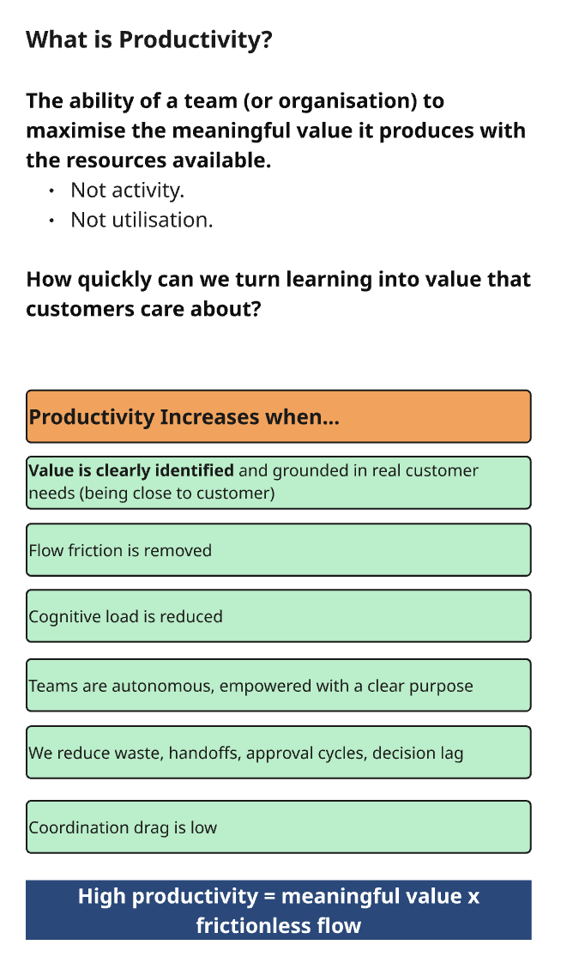
Chris opened the discussion by exploring what productivity means in a Product Operating Model context. The definition is surprisingly simple: productivity equals maximising meaningful value whilst reducing friction.
Rather than measuring activity levels or resource utilisation, productivity focuses on the ability to turn learning about the market and customers into value that customers care about, as quickly as possible. When organisations get this right, business goals naturally follow.
From the discussion, several consistent patterns emerged around what drives productivity in product operating models:
- Clarity on value: Teams need to know how to identify, track and realise value and how to get it out to customers
- Reduced friction: Whether it's demand friction, release friction or governance friction, removing bottlenecks is essential
- Lower cognitive load: Teams need a singular focus, not multiple competing priorities
- Autonomy with alignment: Empowered teams need clear purpose and strategic direction
- Eliminating waste: Handoffs, approval cycles and decisional acts all slow things down
How to build truly cross-functional product teams
Chris highlighted a common pattern: many organisations implementing Product Operating Models set up what they call product teams, complete with product owners, UX designers, developers and QA engineers. His observation: This describes a technology squad, not a true product operating model team.
Drawing from S&S's client work, Chris shared what a genuine high-performing product team looks like. Think of it as two interconnected teams working as one:
The Value Layer brings the customer and value lens: voice of customer representation, operations and contact centre, commercial and credit risk, compliance, legal and security, data analysts and customer forums.
The Delivery Engine provides the technology layer: technical leadership, developers, product owner (spanning both teams), and QA and testing.
This represents digital transformation. It's not about doing Product Operating Models in technology; it's about organisational change management end-to-end. As Chris noted, S&S often creates a virtual "swear box" with clients during product operating model implementation. Every time someone says "business", "technology", “projects” or “programmes” as separate entities, it goes in the box. Very quickly, people start thinking about customers and value instead.
Maximising value delivery in product operating models
Chris emphasised a critical point during the session: "The value and ideas you collate as a POM team mean absolutely nothing if you can't release that value to customers and get feedback."
The best team in the world, truly cross-functional and working brilliantly together, achieves nothing if they can't get value out the door and create feedback loops. This is where organisations need to tackle friction head-on.
Three common POM challenges that reduce flow
Chris walked through three types of friction that consistently emerge when assessing product operating model maturity with clients:
1. Demand management friction in product teams
Important stakeholders ask teams to make changes directly, maybe even suggesting solutions. To protect teams, someone introduces a change process, but this simply reroutes those changes through a bottleneck. Teams estimate, platform teams get involved, priorities shift when stakeholders change their minds, creating a chaotic system.
In a mature POM approach, product teams should drive at least 80% of their own roadmap. Give them a guiding mission statement, clear scope and permission to operate as a mini business. They understand customers, release frequently and adopt a build-it-run-it-fix-it mentality with fast feedback cycles.
2. Platform team bottlenecks in Product Operating Models
Chris shared a challenge he's seeing with clients right now: platform teams saying "We're full until May. Our backlog is overwhelming."
Drawing from successful POM implementations, Chris explained that platform teams should think and act like product teams, making platforms configurable, enabling self-service and driving roadmaps by listening to internal customers.
3. Release pipeline and deployment friction
The third friction point Chris explored involves testing and deployment. Teams deploy into a test phase where everything's tested monolithically, blocking all teams until user acceptance testing completes.
Chris recommended that high-performing product operating model teams can deploy independently, shift left on responsibility, spread UAT throughout the process and use contract testing to decouple dependencies.
Common Product Operating Model transformation challenges
During the interactive segment of the session, participants shared the challenges they're currently facing with Product Operating Model transformation:
- Lack of leadership awareness about Product Operating Model benefits
- Difficulty demonstrating value quickly enough to maintain momentum
- Teams reverting to old ways of working and project-based thinking
- Funding constraints for transformation initiatives
- Lack of consensus and alignment across business and technology
- Understanding the "why" behind moving away from traditional project management
Chris noted these are expected friction points when changing organisational structures, mindsets and behaviours.
One participant raised a particularly resonant challenge: "Big projects getting in the way”, illustrating how the old world fights the new as organisations mature their Product Operating Models.
How to measure Product Operating Model performance
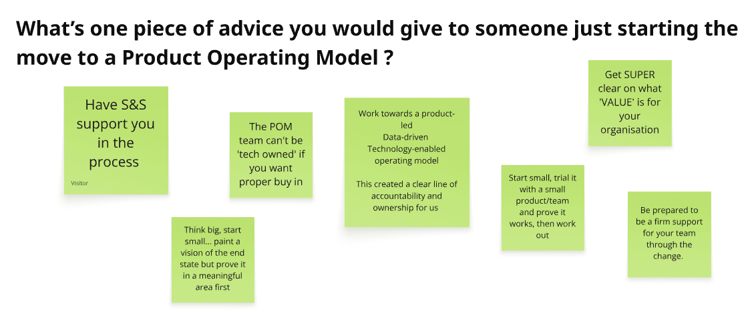
One participant in the session captured this perfectly: "Get super clear on what value is within your organisation." When measuring Product Operating Model maturity and performance, Chris outlined three key areas:
Value creation: Are we creating the right value? Track customer feedback loops, test and learn cycles, outcomes and objectives aligned to strategic goals.
Delivery system efficiency: Are we delivering in a frictionless way? Measure flow efficiency, lead times, change failure rates, deployment frequency and wait times across your delivery pipeline.
Team performance: Do teams have the conditions to keep improving? Assess diversity of cognitive capabilities, autonomy, alignment with business strategy, fairness, innovation capacity, pressure levels, recognition, support and trust. At S&S, we use MissionHub.ai to measure and track these team performance indicators and monitor the organisational environment.
The key is balancing measures. Focusing solely on speed whilst quality dips doesn't deliver sustainable results.
Product Operating Model implementation: start small, then scale
The discussion turned to implementation strategy. Starting small emerged as the preferred approach rather than attempting wholesale transformation.
Chris recommended creating a Product Operating Model pilot: stand up a truly cross-functional product team, establish a value management office to support them and protect the experiment with a guiding coalition.
Get this one product ecosystem working, showcase the value through micro-videos and customer insights, and let the evidence speak for itself. Some stakeholders are concept-based and will buy into Product Operating Model transformation immediately. Others need to see measurable value and business outcomes before they'll commit, even if they're quite senior.
Once you've established this new way of working in one product area, proven the approach and protected it from organisational friction, then you scale to additional teams and domains.
The future of Product Operating Models
The session concluded with a reflection on the journey ahead. Evolving from implemented to high-performing Product Operating Models isn't about having all the answers from day one. It's about facing into the challenges that prevent product teams from reaching their potential, experimenting with practical approaches to reduce friction, and continuously raising the bar on value delivery.
As Chris reminded participants: "We might not have all the answers, but in this room, we certainly have a lot more answers together.”
Ready to Transform Your Product Operating Model?
Join our monthly Community events where we bring together senior executives and leaders from across sectors to share insights, challenges and practical approaches to building high-performing product operating models.
Assess your Product Operating Model maturity: Get in touch with our team to explore how we can support your transformation journey from implementation to excellence.
Download our Orange Papers: Learn more about Mission-Based Working and how AI-powered insights can accelerate your product operating model transformation.