Apple has picked its next CEO. It hasn't picked a strategy.

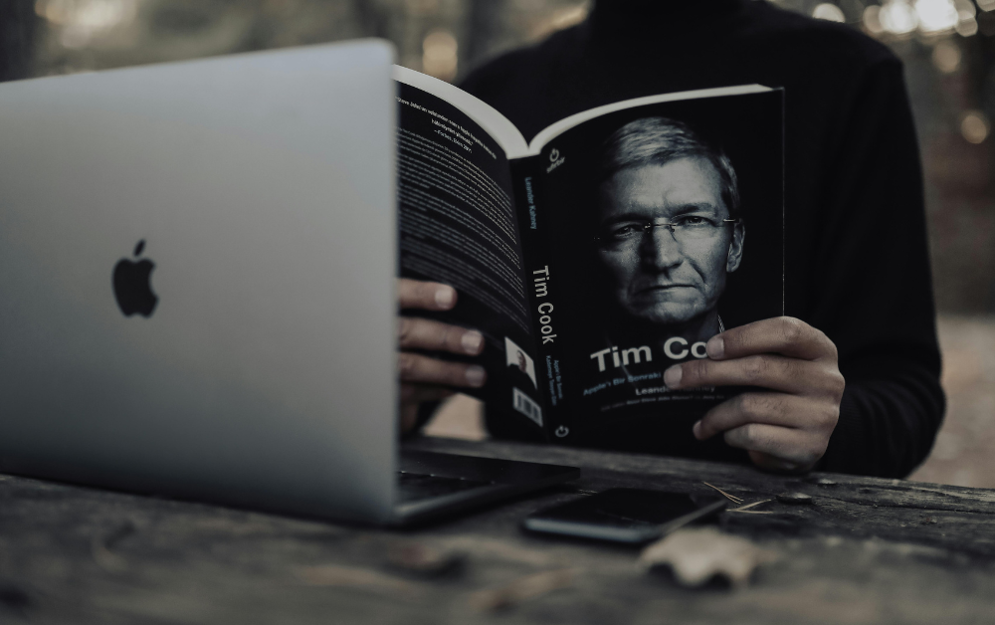
On Monday, Apple made it official. Tim Cook will step aside on 1 September 2026, taking the executive chairman role. John Ternus - Senior Vice President of Hardware Engineering, a man who has spent almost his entire working life inside Apple - becomes the eighth CEO in the company's history.
The commentary has written itself in the usual shape. Jobs was the artist - the visionary, the showman, the man who believed a computer could be a bicycle for the mind. Cook was the soldier - the operator, the supply chain savant who turned a beautiful company into a four-trillion-dollar one. And now Ternus, we're told, is the engineer - a hardware guy, close to the product, who will bring Apple back to what it does best.
It's a tidy story. It's also, I think, the wrong one.
The framework people are reaching for, but only halfway
The artist-and-soldier language comes from Safi Bahcall's Loonshots, a book I've come back to more than most over the years. Bahcall spent a career watching organisations that produced breakthroughs and organisations that didn't, and his argument is structural rather than cultural. Every serious company, he says, ends up with two tribes inside it. The artists - inventors, creatives, the ones who chase loonshots, the ideas dismissed as crazy until they aren't. And the soldiers - the ones who run the franchise, who make the thing at scale, who keep the lights on and the margins fat.
What most people who quote Bahcall miss is what he actually concluded. He did not write a book arguing that great companies need artist CEOs. He did not write one arguing they need soldier CEOs. He argued the opposite. The CEOs who built the most durable breakthrough organisations in modern history - Vannevar Bush at the US Office of Scientific Research and Development, Theodore Vail at AT&T and the original Bell Labs - were neither artists nor soldiers. They were gardeners. Their job was not to have the best ideas or run the tightest operation. Their job was to hold the balance between the two groups. To make the artists and the soldiers feel equally loved. To manage the transfer of ideas between them, not the ideas themselves.
And here is the part that really matters. Bahcall uses Apple as his central case study, and the villain of his story is not the Apple II franchise team. It is Steve Jobs - the first time around. In his first stint, Jobs ran Apple as what Bahcall calls a Moses: he worshipped his pirates on the Mac team, belittled the "regular Navy" working on the cash cow, and created so much hostility between the two groups that the street between their buildings was nicknamed the DMZ. Wozniak left. The Mac failed commercially. Apple nearly went under. Jobs was exiled.
When Jobs came back twelve years later, he had learned something. He loved Jony Ive and he loved Tim Cook, and he made sure both of them knew it. He had stopped being an artist and had become something rarer - a gardener who happened to have excellent taste. That is the Apple that made the iPod, the iPhone, the iPad. Not the artist Apple. The gardener Apple.
So what did Cook actually inherit, and what did he do with it?
Cook took over a gardener's Apple and ran it brilliantly as a soldier. The numbers don't lie. Apple's market capitalisation grew more than twenty-fold on his watch and closed on the day of the announcement at four trillion dollars. He absorbed a generational shock - Jobs's death weeks after handing over - and did not break stride. He built Services into a hundred-billion-dollar annual business. He navigated China, navigated tariffs, navigated an antitrust environment that would have flattened a less patient leader.
But something happened along the way, quietly, that the tidy narrative tends to skip over. The artist side of the company got thinner. Jony Ive left in 2019. The design language that had defined Apple for two decades drifted into refinement rather than reinvention. John Giannandrea, Apple's AI chief, retired at the end of 2025 with his organisation broken up and redistributed. Siri's revamp has been delayed and delayed again. The Vision Pro, launched with enormous fanfare, has landed with a thud heavy enough that Apple is already pivoting towards glasses for late 2026 - racing directly into a category Meta has had on the shelves for three years.
And here is the detail that should make every Apple watcher stop and stare. The man now designing OpenAI's AI hardware device is Jony Ive. The man running hardware design under Ive at OpenAI is Tang Tan, a former Apple VP. The team is stuffed with dozens of engineers poached from Apple's iPhone, iPad, Watch and Vision Pro programmes. Ben Thompson put it more cleanly than I can: the question of Apple's next fifty years may be whether OpenAI can out-Apple the original.
Apple hasn't just lost an artist. It has lost its artist to a rival that is now using Apple's own playbook against it.
Where Ternus actually fits
Read the coverage and you'll be told, again and again, that Ternus is an engineer and therefore close to the product, and that this is what Apple needs now. I want to be careful here, because there is a real case to be made for him. If the next computing platform is wearables - glasses, cameras in AirPods, successors to Vision Pro - then hardware engineering is the battlefield. Apple Silicon is already the company's most quietly dominant advantage, and Ternus understands that silicon-plus-device integration in a way few leaders anywhere do. The "adult in the room" strategy - integrated, private, on-device intelligence rather than frontier-model spending - plays to exactly the strengths a hardware-native CEO would double down on.
That is the optimistic case, and it isn't a silly one.
But here is the Bahcall-shaped concern. Engineers fall into a different version of the Moses trap than artists do. They do not worship the loonshot. They worship the craft. They can spend years perfecting the fit and finish of a device while the platform shift is happening somewhere else entirely. It is the Nokia story. And you can make a respectable argument that it is already the Apple story with Vision Pro - an engineering triumph, a strategic miscalculation, a product that answered the question "what is the most technically impressive headset we can build?" rather than "what is the AI-era computing platform people actually want?"
Engineers are a type of soldier. A very sophisticated type, often indistinguishable from artists in the details of how they work, but soldiers in Bahcall's structural sense. They optimise. They refine. They make the franchise hum. And if you put a soldier at the top of a company whose artist wing has been hollowed out, you do not get a new era. You get the old era getting more efficient at what it already does.
The question nobody is asking
Jobs needed Cook to be great. Cook needed Ive to be great. The history of Apple for the last twenty-five years has been the history of the pairing at the top, not the single figure.
So here is the question I have not seen asked about Ternus.
Who is his artist?
I genuinely don't know the answer, and I don't think Apple does either. The two executives promoted into Ternus's old portfolio - Johny Srouji taking over hardware and Molly Anderson moving into a broader design remit - are, by every available account, two of the best soldiers in the business. Srouji built Apple Silicon. That is not a small thing. But it is a thing in the same family tree as what Ternus already does. Apple is about to be run, from the top of the executive team down through its most senior hardware leadership, by people who share a common professional DNA.
That is a team optimised for one kind of future: the one where Apple's existing bet is correct and the job is to execute it with ever more precision. Integrated hardware, on-device AI, glasses as the next platform, Silicon as the moat.
If that bet is right, Ternus is the ideal CEO. The stock will probably do very well.
If the bet is wrong - if the next platform turns out to be something stranger, something more agentic, something designed by the artist who left and is now working elsewhere - then Apple has just installed the leadership it would need to win the last war, at the precise moment a different one has started.
The misdiagnosis
Here is what I think is actually happening, and why I opened by saying the announcement is a succession rather than a strategy.
The story Apple has told the world - artist, soldier, engineer - is a comforting progression. It suggests that each era got the leader it needed. It treats CEO succession as a relay. It also happens to be the story that requires the least change from the company telling it.
The Bahcall story is less comforting. It says the question is not what flavour of leader you have. It is whether anyone in the building is minding the balance between the two tribes, and whether both tribes are still in the building at all. By that measure, Apple's problem is not that it has picked the wrong CEO. It is that it has a beautifully engineered, commercially formidable soldier-led company that has quietly lost the artist half of what made it Apple in the first place, and the succession plan has not addressed this. It has, if anything, confirmed it.
Ternus may well be the right man for a particular kind of future. The question Apple has not answered - possibly has not asked- is whether that is the future it's actually walking into.
I'd love to be wrong about this. Apple is a great company that has survived the premature writing of its obituary more often than any other in modern tech. But I would feel very differently about this transition if alongside the Ternus announcement, we had heard the name of his artist. We didn't. And the silence on that point is, I think, the story that matters.

Adrian Stalham
Chief Change Officer